

Built to
come back
For most people, orbit is still a distant place. We think it should be a routine one. Rebound is developing reusable rockets, and engines designed to fly again without being taken apart, so the time between flights shrinks from weeks to hours.
Ready to see how?Rebound designs its vehicles around propulsion it develops in-house
From first fire to full reuse
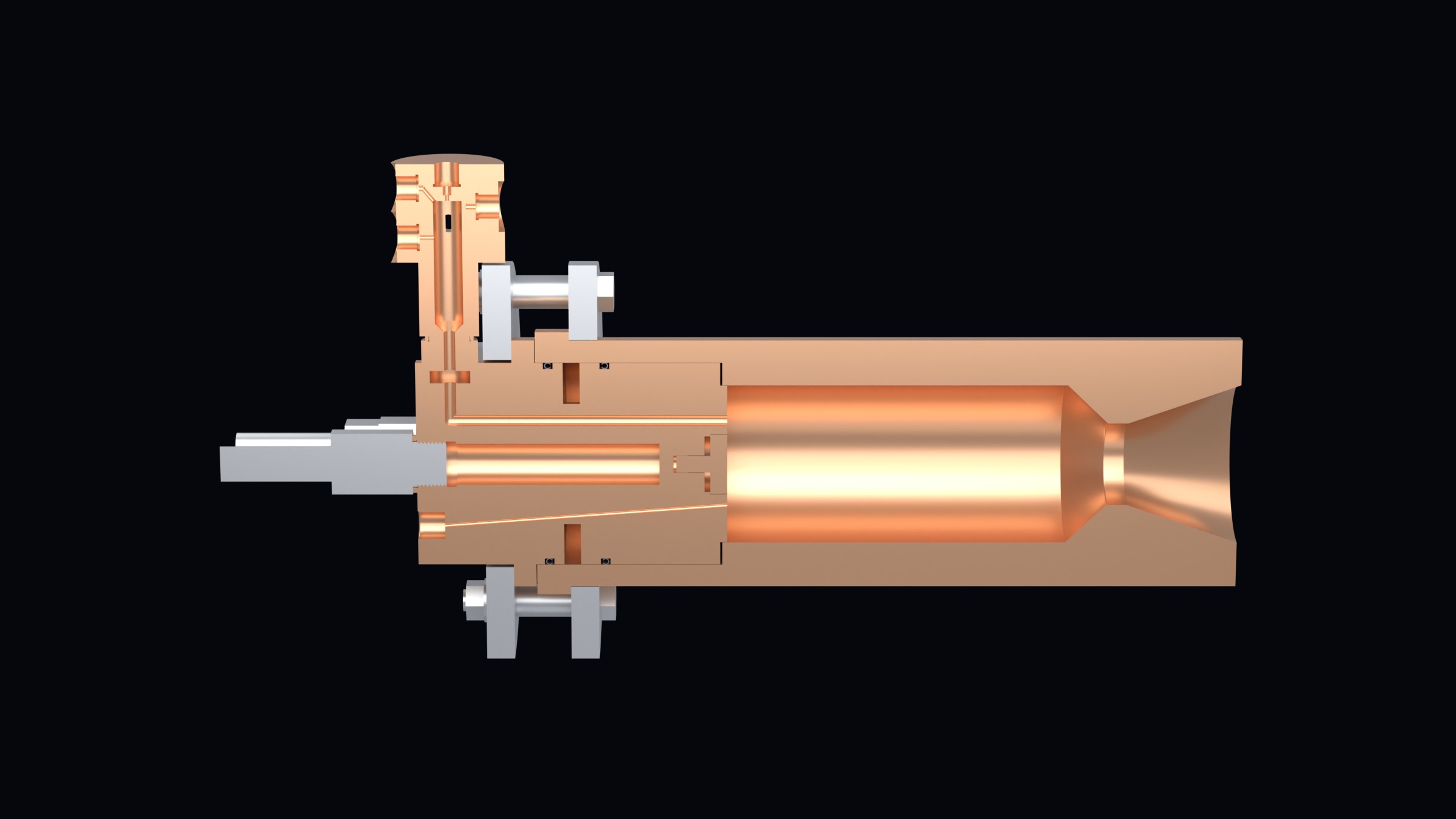
Firstfire L1-D1T4 · LOX / E85 · CAD geometry · not released for manufacture
Propulsion
Every rocket starts on the ground. Ours starts with Firstfire, a 1.5 kN liquid-oxygen and E85 engine.
A solid copper heat-sink chamber, a drilled copper injector head, metal-seated ports and a spark torch igniter. Its 29.80 mm throat and nozzle were checked with SU2 flow simulation at about 1.54 kN.
It is small on purpose. The first firing is a single 5-second burn from cold, planned to prove the team, the instrumentation and the test process that every larger engine depends on. The design is finished to quote-ready drawings, with its feed system, test stand and firing sequence written out.
- Design thrust
- 1.5 kN
- Chamber pressure
- 18 bar
- Propellants
- LOX / E85
- Mixture ratio
- O/F 0.95

Launch vehicle
Both stages come home.
A two-stage rocket where the booster returns to the launch site and the upper stage delivers its payloads in low Earth orbit, then comes back to be caught by the launch tower.
- 017booster engines on a shared engine design
- 0215 tpayload target to low Earth orbit; the current model gives about 16 t to a 400 km, 53° orbit, about 19 t at 28.5°, 8.7 t to a 500 km sun-synchronous orbit from Vandenberg, 5.1 t from Florida
- 0381 mtall, 6.0 m diameter, about 1,420 t at liftoff, both stages reusable
- 04Tower catchupper stage returns to the pad, booster lands back at the launch site
- 0524 hrelaunch target for the same vehicle
These are development objectives from our design models, not demonstrated performance. Nothing has been fired or flown. Flight design, recovery, turnaround, capacity and price are not yet established.
Progress log
Where we are today: the Firstfire test engine and the 20 kN proof engine are designed and documented. Fabrication and testing are ahead. No engine has been fired and no vehicle has flown.
-
Vehicle re-closed with a larger booster landing reserve: 81 m tall, about 1,420 t at liftoff, on paper about 16 t to a 53° orbit in NASA’s GMAT
Rebound
-
Vehicle re-sized around the booster engine as designed: 2.7 MN engines, a 6.0 m wide booster to fit all seven, 80 m tall, on paper about 16.6 t to a 53° orbit in NASA’s GMAT
Rebound
-
20 kN proof engine drawn to build
Rebound
-
First full booster engine modelled: turbopump, injector head and cooled nozzle generated as one part
Rebound
-
New engine direction: a booster engine that is never opened between flights, built for 24-hour turnaround
Rebound
-
Aerospike study closed: no gain large enough for a two-stage reusable booster
Rebound
-
First firing set: one 5 s cold burn at O/F 0.95, throat 102 °C under its temperature screen
Rebound
-
Firstfire moves to liquid oxygen and E85: 1.5 kN, 18 bar, 29.80 mm throat
Rebound
-
First working version of our Design Studio
Rebound
-
Firstfire program starts: a 1.5 kN copper heat-sink test engine
Rebound
-
Cold flow. Then first fire.
Test site, feed system and instrumentation first
Engines fueled
by people
Team
Rebound is early. That means the people who join now shape the engines, the vehicle and the company.
Our next priority is specialist propulsion engineering and test experience. If you want to put your talent into hardware that flies again, we'd like to meet you.
Join the team